The Quiet Corner of Aerospace Just Got Very Loud
Aviation Week's Kevin Michaels lays out what many in the defense propulsion world have been feeling for the past few years: the small military engine market is undergoing its most significant transformation in decades.
For most of the post-Cold War era, engines under 5,000 lb. thrust were a sleepy backwater. Modest volumes, incremental innovation, "good enough" performance. That era is over. Michaels identifies five converging forces driving the shift.
- The cost-exchange problem. Ukraine and the Middle East proved that spending a $2M interceptor to kill a $50K drone is not a sustainable strategy. The math has to change.
- Affordable mass programs. FAMM, LCCM, ERAM — all designed around the assumption that future inventories must be deeper and replenishable at speed.
- Collaborative Combat Aircraft (CCA). Shorter service lives, lower acquisition costs, and entirely new engine families to support them.
- Stockpile replenishment. Tomahawks, JASSMs, and other turbofan-powered weapons need production rate increases after the Iran conflict.
- Global fragmentation. Ukraine's Flamingo cruise missile, Japan's new standoff weapons, Europe's Stratus program. More countries building their own.
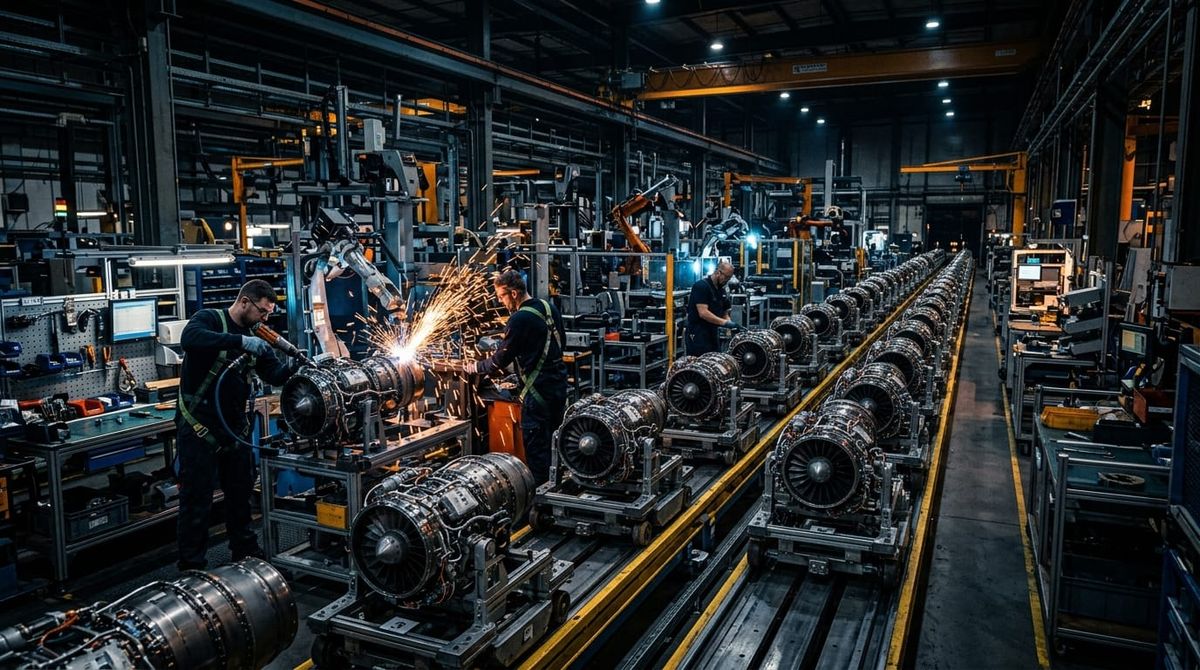
AeroDynamic Advisory expects production of small military engines to double in the next three years and exceed 8,000 per year by 2028.
That number matters. When you go from hundreds of engines a year to thousands, every subsystem in the propulsion chain faces the same question: can you scale?
This is where the article gets particularly relevant for companies operating in the propulsion supply chain. The new entrants Michaels names — Beehive Industries, Anduril, Kratos/GE, PBS Group, and others — are not just building engines. They are building production ecosystems. And the Pentagon's expectations are clear: technical performance alone is not enough. You need manufacturing discipline, quality assurance, affordability, and the ability to ramp fast.
Fluid delivery, fuel management, and thermal systems are the connective tissue of every one of these engines. When the industry moves from "good enough" to "thousands per year at a fraction of the cost," the companies that own standardized, modular, production-ready subsystem solutions are positioned to be force multipliers across the entire market.
Small engines. Enormous stakes.